
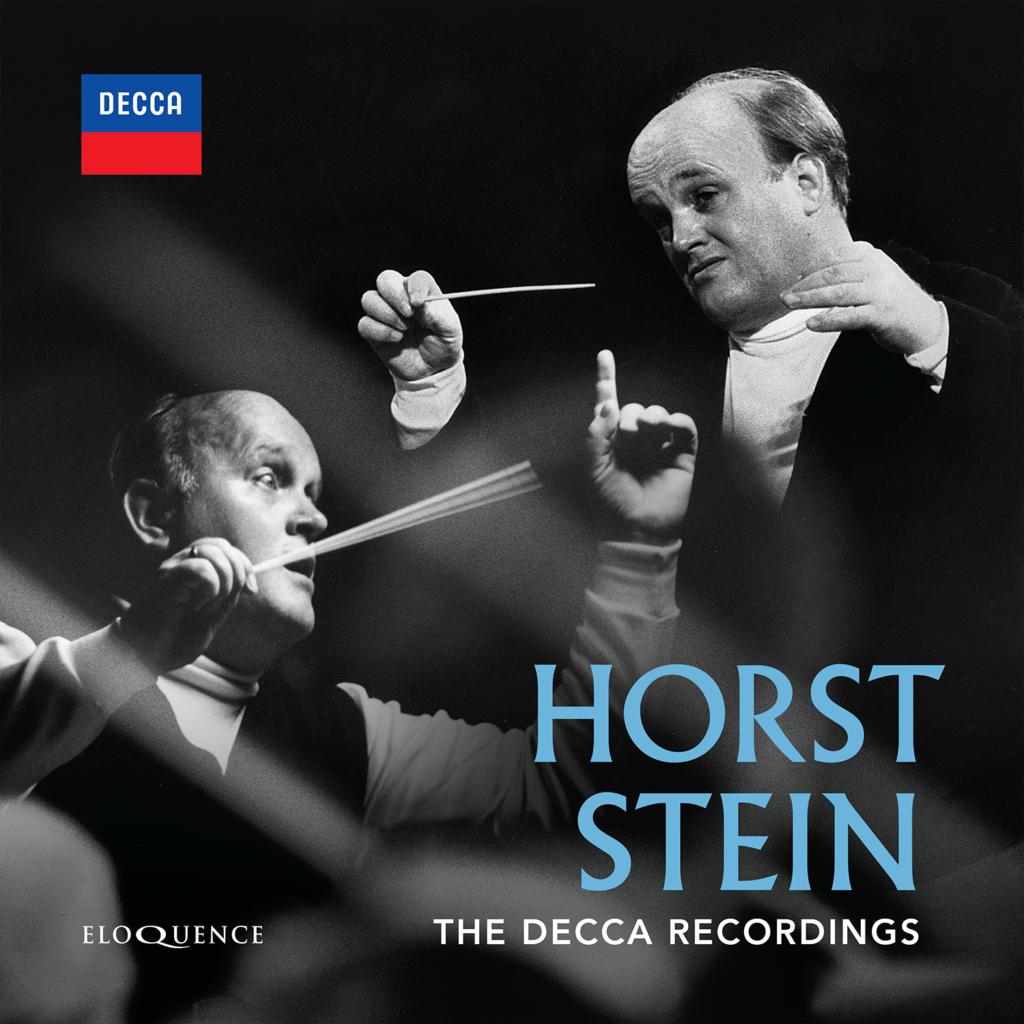
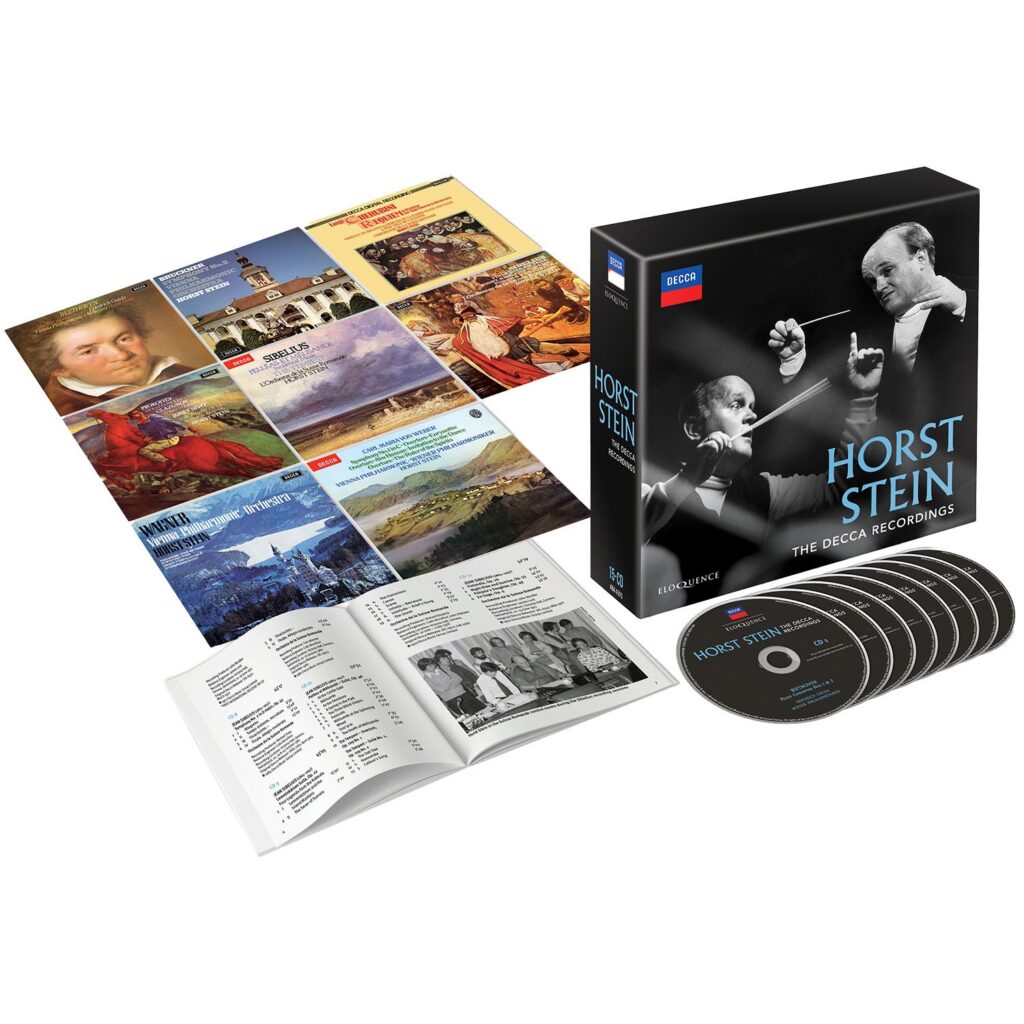
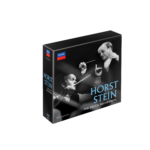
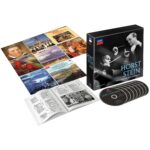
The complete Decca recordings of German conductor Horst Stein cover an astonishingly wide range of repertoire, with Friedrich Gulda in the ‘very spontaneous, very lyrical Beethoven concerto cycle’ (Gramophone), through music by Cherubini and Weber, to critically-acclaimed recordings of Bruckner, Wagner and Wolf. Included are four discs of his colourful Sibelius: ‘free-wheeling readings of great thrust, drive and a big line … The sound is at once biting and smooth’ wrote High Fidelity.
The complete Decca recordings of a Horst Stein, directed with the unfussy authority of his many appearances at Bayreuth and the Vienna State Opera. The recordings in this set, cover an astonishingly broad range of repertoire. Beethoven concertos (with Friedrich Gulda, once a staple of the Decca catalogue), Cherubini, Prokofiev, Bruckner, Sibelius: all writing in completely contrasting idioms, and yet all brought stylishly to life here under the baton of Horst Stein.
Stein learnt his craft as an opera conductor in postwar Bayreuth, where he served as an assistant to Karajan, Keilberth and Knappertsbusch in celebrated performances of the Ring and Parsifal. He later became known for the expert pacing and dramatic pulse of his own Wagner conducting, which is represented in this set by an album of orchestral highlights with the Vienna Philharmonic.
Stein worked in Bayreuth and Vienna throughout his career, and later in life became a revered figure in Japan. He represented the best of the German Kapellmeister tradition, which produced straightforwardly eloquent and powerful performances of whatever music was at hand. When Stein conducted Bruckner – the Second and Sixth, again recorded in Vienna – he sounded like a natural Brucknerian. When he recorded Sibelius – four albums of tone poems and the Second Symphony from Geneva – he sounded like a complete Sibelian, and so on.
As an addendum to his Decca output comes an album of Russian opera arias with the bass Kim Borg recorded for Deutsche Grammophon. Just as Stein lends noble support to Borg in the Death Scene from Boris Godunov, he is a detailed accompanist to Josef Sivó in violin concertos by Glazunov and Prokofiev, and to Friedrich Gulda in the piano concertos of Beethoven. Horst Stein’s conducting will impress many modern listeners with its rhythmic power and lack of ego, and this set is the most comprehensive survey of his legacy on record ever issued.
CDs 1–3
BEETHOVEN
Piano Concertos Nos. 1–5
Friedrich Gulda
CD 4
BRUCKNER Symphony No. 2
CD 5
BRUCKNER Symphony No. 6
CDs 6
CHERUBINI Requiem
CD 7
GLAZUNOV Violin Concerto
PROKOFIEV Violin Concerto No. 1*
Josef Sivò
*FIRST INTERNATIONAL RELEASE ON CD
CD 8
SIBELIUS Symphony No. 2
CD 9
SIBELIUS Lemminkäinen Suite
CD 10
SIBELIUS Pelléas et Mélisande
The Tempest
CD 11
SIBELIUS Finlandia
Night Ride and Sunrise
Pohjola’s Daughter
En Saga
CD 12
WAGNER
Overtures & Preludes
CD 13
WEBER Overtures
Aufforderung zum Tanz
Symphony No. 1
CD 14
WOLF Penthesilea
Der Corregidor
CD 15
Opera Arias
Hilde Gueden
Kim Bor
“Horst Stein … shows himself a sympathetic Sibelian …These are free-wheeling readings of great thrust, drive and a big line … The sound is at once biting and smooth.” High Fidelity, August 1973 (Sibelius: Nightride and Sunrise, etc.)
“Sivó does splendidly … The idiom seems second nature to him [Glazunov] … The Suisse Romande backs him beautifully … His tone is always firmly focused, and he captures with perfect understanding the sardonic twist necessary [Prokofiev].” High Fidelity, June 1973 (Violin Concertos)
“Sivó and Stein collaborate in perfect accord for these performances.” Stereo Review, May 1973 (Violin Concertos)
“Performances that intrigue the ear, the mind and the heart, and conductor Horst Stein and the Vienna Philharmonic accompany [Gulda] to perfection.” Stereo Review, July 1973 (Beethoven: Piano Concertos)
“The first movement is properly heroic and assertive … this sensitive and well-shaped interpretation. The lyrical phrasing of the [Adagio’s] closing pages could hardly be bettered.” High Fidelity, January 1976 (Bruckner: Symphony No. 6)
“A good choice for anyone wanting just one record of Weber’s orchestral poetry, particularly when Mr. Stein’s direction is so elegant and the playing is so witty and colourful.” The Times, July 1978
“Splendidly recorded, and accompanied by Stein and the VPO with beautifully alert and well-proportioned playing, this is perhaps the most dazzlingly stylish account of the work now before the public.” Gramophone, July 1979 (Beethoven: Piano Concerto No. 4)
“Friedrich Gulda’s very spontaneous, very lyrical concerto cycle has been too little noticed … Gulda’s and Stein’s spontaneity encompasses grandeur as well as poetic fancy … The recording catches the orchestra magnificently.” Gramophone, December 1977 (Beethoven: Piano Concerto No.5)
“Horst Stein’s splendid version strikes the best balance of affection and delicacy.” High Fidelity, September 1979 (Bruckner: Symphony No. 6)
“This heartfelt performance … should acquaint people with the very considerable beauties of this music.” Stereo Review, August 1981 (Cherubini: Requiem)
“Horst Stein both demands virtuosity and gets it.” Gramophone, June 1972 (Sibelius: Nightride and Sunrise, etc.)
“It is clear that Mr. Stein has a genuine feeling for Sibelius, and he deserves every congratulation on these performances.” Gramophone, August 1972 (Sibelius: Nightride and Sunrise, etc.)
“Nothing but praise; especially for the superb playing Stein gets from the VPO … This is much to be recommended.” Gramophone, July 1974 (Wagner: Orchestral excerpts)
“Stein’s gifts as a Wagner conductor have enabled him to see the richness and depth already glimpsed in this early work of Weber’s … playing of this warmth and enthusiasm brings out the music’s strengths.” Gramophone, September 1978 (Weber: Symphony, etc.)
“Performances … that yield nothing to the competition … Stein is a wonderful Sibelian, with an intuitive feel for that peculiar sense of musical movement by which a Sibelius performance lives or dies … The Swiss orchestra sounds uncommonly good.” High Fidelity, July 1980 (Sibelius: Nightride and Sunrise, etc)
“This is easily the choice performance of this underrated work, an unhesitating recommendation.” Fanfare, July 1981 (Cherubini: Requiem)
“Horst Stein’s rendition … is very good, and he is aided by Decca’s excellent sound … Stein shows much feeling for the liturgic spirit” High Fidelity, January 1982 (Cherubini: Requiem)
“Stein’s performance makes no apologies for the work … an important discovery.” Gramophone, February 1982 (Wolf: Penthesilea)
“The overture to The Flying Dutchman is beautifully shaped and paced. He restrains the passion of the Tristan Prelude, allowing it to build gradually until he unleashes it at the climax.” Fanfare, November 2017 (Wagner: Orchestral excerpts)
“Stein’s Sibelius legacy ratchets up added tension and delivers a surer punch … Right from the opening bars of En Saga you sense that this version really is going places.” Gramophone, March 2016 (Sibelius)
“The performances, whether they originate in Geneva or Vienna, are first-class all the way.” Fanfare, November 2017 (Wagner, Weber, Wolf)