
Peter Quantrill provides a fascinating glimpse into the history surrounding rare Hungarian recordings released on a limited Deutsche Grammophon edition.
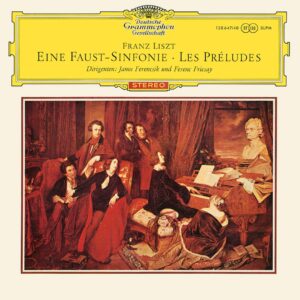
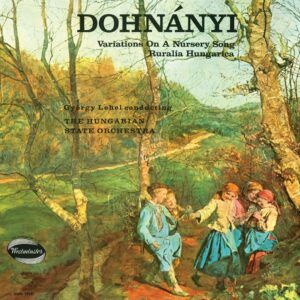
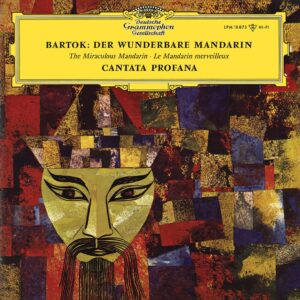
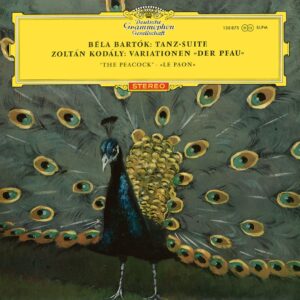
It was no easy task for major commercial labels to record musicians from behind the Iron Curtain during the Cold War. A label such as Deutsche Grammophon could take one of three options. They might wait for the musicians to undertake a rare tour westwards, as the Czech Philharmonic and Karel Ančerl did when DG recorded them in Shostakovich’s Tenth in 1955. Or, more adventurously, they might succeed in brokering a deal, often as not with the aid of a third party, which allowed their production teams to travel and record in situ, as Decca did (also in 1955) for a series of seven operas in Belgrade.
More common, however, was the licensing solution, whereby the western commercial label would acquire recordings made by the state-run label of the relevant country: Supraphon in Prague, Polskie Nagrania in Warsaw, Hungaroton in Budapest. Cold hard cash was not the currency here: Czech and Polish and Hungarian listeners were no less eager to hear French and German and British artists than the other way around, and DG, Decca and EMI were among the companies striking such reciprocal deals even into the 1990s.
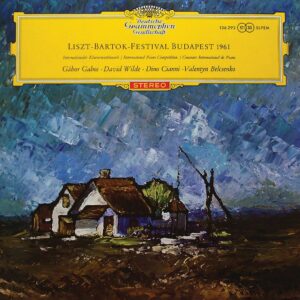
So it was, for example, that DG issued a single-LP of highlights from the 1961 Liszt–Bartók Piano Competition held in Budapest, later renamed the Franz Liszt Piano Competition. At that stage Hungaroton was known as Qualiton and had already released a 3-LP box of performances featuring all six prize-winners, an entente cordiale list of young pianists from both sides of the Curtain. DG cherry-picked tracks from the top four, headlining with the obvious choice of the Liszt Sonata as played with imperiously Hungarian balladry by the 31-year-old joint first prize-winner, Gábor Gabos.
Sharing that first prize, for the only time in the competition’s history, was the English pianist David Wilde. In his unpublished memoirs, Wilde recalls the event in detail, and sketches the character of a city, and a nation, still licking its wounds resentfully at the Soviet invasion five years earlier, when Red Army tanks had rolled through the broad boulevards of Budapest in order to quell a popular revolution. Imre Nágy, prime minister and hero of the rebellion, had been seized en route for General Tito’s Yugoslavia before being summarily tried and hanged.
The death warrant was signed by the former Interior Minister János Kádár, who was more willing than Nágy to negotiate with the USSR and remain within its sphere of influence. In fact, Kádár would survive in post until his retirement in 1988, and by 1961 was already steering a precarious but durable compromise between Communist and ultimately Soviet rule, and openness to Western liberalism in its various forms, which was after all the heritage of the country once at the geopolitical centre of Europe.
As one of the first Western visitors to Budapest since the failed revolution, Wilde found young Hungarian children gathering around him in the street as if he were an alien (which, in one literal sense, he was). His translator and minder, Fedora Karczag, was no stooge but the former wife of a diplomat with whom she had once lived at Eaton Square in pre-war London. Early in the competition, she had taken him to see Sviatoslav Richter play Liszt’s Second Concerto with the Hungarian State Orchestra under the baton of János Ferencsik, who plays a central role in this box. ‘After that,’ she remarked to him in friendly fashion, ‘you can all go home!’
In the event, Wilde found the Soviet delegation at the competition entirely hospitable. ‘They invited the British contestants to a party, and as we left, one of them called down the stairs, “Tell the United Nations to go home; we’ll have only piano competitions instead!” As none of us spoke Russian, we naturally became most friendly with those who spoke English best, and foremost among them was the charming Valentin Belchenko’ – the Moscow-born pianist whose performance of Funérailles is included in the DG highlights album.
Wilde recalled his first-round performance of Mazeppa preserved here as a ‘barnstormer’ of a performance which elicited a gasp at the end from the audience (as well it might) who otherwise were discouraged from applause at this stage of the competition. The stipulation for the final round demanded Liszt’s B minor Sonata and a Liszt or Bartók concerto, to be accompanied by the Hungarian Radio Orchestra under György Lehel, the other maestro celebrated in this anthology.
Wilde gave Liszt’s First Concerto, whereas the eventual second-prize winner, Dino Ciani, took a bolder option with Totentanz. ‘He was not popular with the public,’ recalled Wilde, ‘because he was a Communist Party member and widely regarded as the Party’s candidate … There were those who felt that he, and not I, should have taken first place, and I believe that Dino himself was of that opinion. There is much to be said for this view. He was more at ease, more polished than I was … So why did Dino not take the first prize?
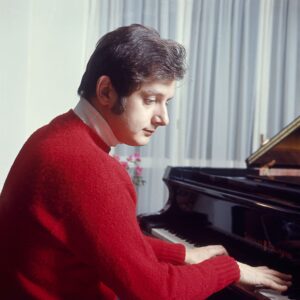
Dino Ciani
‘I’m inclined to think that his good fortune was also his undoing,’ reflected Wilde. ‘The tradition of Cortot was audible in his playing: however, this was not a Liszt, but a Liszt–Bartók competition – and Bartók was far from Cortot. And although Dino understood the Debussy-influenced impressionistic aspect of Bartók’s music well, and played his notoriously difficult Out of Doors Suite with suave mastery, much of Bartók’s style was too remote from his pedagogical and personal background: both its peasant earthiness and its dissonant 20th-century radicalism eluded him. My studies with Franz Reizenstein and Richard Hall had equipped me to handle European music written between the World Wars, and I believe that even the struggles and tensions resulting from years of pedagogical and personal conflict which were often apparent in my playing contributed something to the performance of such music and to the Sturm und Drang element in Liszt’s works.’
Wilde’s reflection is worth quoting at length because it gets to the heart of what makes the music in this box Hungarian, and what gives these performances the ring of authenticity. The respect which Ferencsik and Lehel commanded among musicians in Hungary, especially younger ones, can scarcely be overstated, or nowadays fully grasped. Hungary was – is – a nation with a deeply rooted culture of musical excellence, before first the Nazi and then the Soviet occupation took their axe to the base of the tree. Long before the rise of the Nazis, Fritz Reiner and Eugene Ormandy had followed Artur Nikisch to the US and made their fortunes there. They were followed in time by George Szell, Georg Solti, Antal Doráti and others. In conversation with the present author, the Hungarian quartet leader and conductor András Keller recalled his teacher Ferencsik with affection: ‘He was the one who stayed. He was one of the last big heroes.’
In a 1972 interview with the Hungarian writer and musicologist Peter Várnai, Ferencsik cited Nikisch as his own ‘big hero’. ‘I heard a lot about him from old musicians from Pest and Vienna who played under his baton. Nikisch was a magician, so they said; the sound and playing of an orchestra was completely transformed when he was on the podium. That’s what I would like to achieve, just to stand in front of the orchestra, but not actually be there, as if the orchestra itself wanted what I had in mind. To merge completely with the orchestra – in this sense, Nikisch is my role model.’
In more pragmatic terms, Ferencsik learnt most from observing and assisting three foreign conductors of a later generation on their visits to Budapest in the 1930s: Arturo Toscanini, Fritz Busch and Erich Kleiber. ‘Busch and Kleiber accepted me as a friend and we had intimate conversations, especially about music. There was an electricity about Kleiber that set even the laziest grey matter in the brain in motion. How did he achieve this? I can only think of one word: his personality. I learned from Busch that a conductor has to be very aware of what he wants and how he wants it. He must say everything in a few words, but those few words must be clear and unambiguous.’
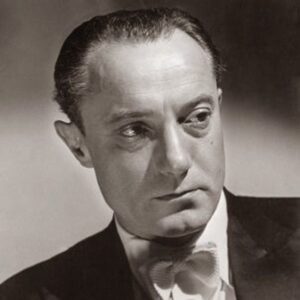
János Ferencsik
Ferencsik then became an assistant to Toscanini at the Bayreuth Festival. ‘Here I was completely under Toscanini’s spell, attending all his rehearsals and, of course, all his performances. The only downside of this was that it affected my hands and my technique a little. And since Toscanini was not one of the “technical” conductors, this effect had to be eliminated afterwards, and my movements had to be put back in place.’
Even a summary account of Ferencsik’s career deserves to include his childhood memory of a Christmas gift. ‘I was a little child when I asked Jesus for a violin. He delivered, but it turned to sorrow and weeping, because the earthly representatives of Jesus – my parents – put a toy violin under the Christmas tree. I tried it immediately and because the violin was made of tin and sounded like tin, I cried bitterly. And so it was perhaps the only year in the history of the world that Christmas came twice, because my parents invited Jesus to return – perhaps for Epiphany – and he brought a proper violin, a small one of course.’
A lodger’s rented piano enlarged Ferencsik’s musical vocabulary, but it took the organist of the local church to teach him the grammar. As a child barely old enough to reach the pedals, he was playing the organ with his left hand (and his feet) and conducting the choir with his right. By the age of twenty, he was an organ student by day and an employee of the Budapest Opera by night. From there on, he began climbing the same ladder as Szell and Böhm and others in their time; the hard way but also the only way. ‘Fritz Busch told me that the opera conductor is like the trapeze artist: if you don’t start learning at a young age, you fall off the trapeze. If you don’t go down the challenging path that starts out as a repetiteur, you won’t become an opera conductor. Then you can cross over into the symphony field, but not vice versa. Those who have tried have failed.’
One reason for this, thought Ferencsik, is that conducting opera and coaching singers teaches the art of musical gesture, which could hardly be more relevant than in the directly illustrative tone-poems and symphonies of Liszt. Having continued to work at the Budapest Opera throughout the war, he became the company’s General Music Director in 1945, and soon afterwards began taking up international engagements such as the Vienna State Opera. However, the new Communist regime then prohibited him (along with the baritone Sándor Svéd and the bass Mihály Székely, for example) from working abroad.
The revolution presented a watershed moment, when many musicians such as György Ligeti fled their native country. Ferencsik stayed. ‘I thought it was the smart, good and only right thing to do.’ In staying until his death in 1984, he maintained the highest standards at all the major musical institutions in Budapest, most influentially as a teacher. In 1972, he looked candidly back at his limitations. ‘I tried Schumann, but I gave up.’ The same went for Mahler and Bruckner. ‘I must confess that the two great Hungarian composers, Bartók and Kodály, and the Viennese classics, are the closest to me … I feel at home in this music, I move so naturally here that I hardly have to think about what I am doing.’
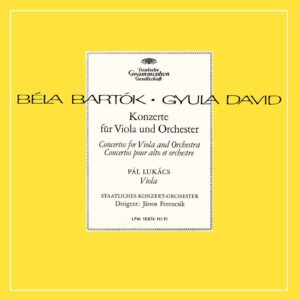
Ferencsik also did what he could for living Hungarian composers – at least the ones writing in conservative tonal idioms – among them Gyula Dávid, represented in this collection by the Viola Concerto. In fact, the Concerto dates from 1951 and yet sounds older than even Bartok’s distilled late-style classicism in his own Viola Concerto. Born in Budapest in 1913, David was himself a violist and wrote for his instrument with a warmth which even the rather distant recording cannot dim.
The sleeve-note writer for Deutsche Grammophon heard distinct echoes of Beethoven alongside David’s adoption of a folkloristic vein, whereas the annotator for Hungaroton was at pains to emphasise the augmented fourths and Lydian-mode writing of the finale, thus underlining its Hungarian character. These differences of perspective serve to remind us of the political dimensions of this music – perhaps all the more potent when unconsciously interpreted – which change over time even when the notes stay the same.
Take the LP releases of Lehel conducting Bartók’s Music for Strings, Percussion and Celesta. On the East-German Eterna label, the note writer outlines the four movements entirely in terms of their tonal conflicts and progress. For the composer and violist Antal Molnár on Hungaroton, however, the drama is a human one beginning in deepest anguish, its conclusive resolution an exemplar of ‘the music of the 20th century’s moral strength!’ Bartók tended to leave his music to do the talking, but Lehel himself was in a well-informed position to know that ‘apolitical’ music-making is a chimera, especially in turbulent times.
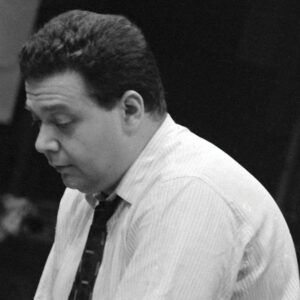
György Lehel
Born in February 1926, Lehel picked up the violin at a tender age, like Ferencsik, and in his teenage years he began to conduct the orchestra of his high school. He pursued private studies in conducting and composing in Budapest through the course of the war, and recalled what happened next in a 1981 interview, reprinted by Éva Bieliczkyné Buzás in her 2006 biography. ‘I came home from my studies in February 1945, and after everything had been destroyed, I immediately went to work – it didn’t matter what, just to earn something, for a chance to live.’
Through friends Lehel secured a post at the Council of Public Works in Budapest, which later became the National Government Commission for Construction. This soon proved unrewarding, and it was thanks to the offices of Peter Várnai, working at that stage as a radio producer, that he was able to join Hungarian radio as a jobbing conductor, doing daily live broadcasts of light and classical concerts.
When Lehel joined in 1946, the station was based on Esterházy Street, later renamed Pushkin Street. ‘There was a beautiful old restaurant called Sörkatakomba, with a huge garden and big walnut trees. Not only did we go there to eat, but the waiters would bring our dinner to the studio on a tray. Then [the Communists] stopped that too.’ Lehel and his colleagues began to make radio documentaries, such as a history on the evils of fascism. All the record stores were in ruins, so they had to record the relevant material afresh. This they did by hiring the band of an infantry regiment to play old marches from the hated Nazi and Horthist regimes. ‘This must have been around the autumn of 1946, early ’47. I hadn’t heard such liberated, happy music-making in a long time, as they were able to play once more what they’d been used to playing for decades. It was a comic situation.’
Lehel rose through the ranks at the radio, becoming music director, head of department – ‘at the age of twenty-something’ – and then editor-in-chief, a responsibility with its own set of political conditions. ‘Over half of the output had to be Hungarian, Russian or Soviet music over 25%, and everything else had to be squeezed into the remaining 21-22%. If by chance this proportion could not be achieved, we were in trouble, and the schedule had to be planned again from scratch.’ All the while, he was conducting much of this music, learning from older and now largely forgotten colleagues such as Rezső Kókai, Tibor Polgár and László Somogyi.
The radio studio became Lehel’s equivalent of Ferencsik’s Budapest Opera pit, in which he was required to put on new broadcast productions of operettas every week, often with the same singers. He, too, began to receive invitations from abroad, including the Vienna Philharmonic, until the Curtain came down in 1948. ‘We lived in absolute seclusion for years. In 1952 the Radio Orchestra’s first tour to Poland was such a huge thing that to say today that one goes to the USA is nothing compared to that.’
By 1981, Lehel estimated that he had given 1700 concerts with the radio orchestra which features on several of the albums in this set. By the time of his death from lung cancer in September 1989, he had conducted the first performances of 219 pieces by 58 different Hungarian composers since 1950. Just as the DG album of the 1961 Liszt–Bartók Competition presents less than half of the recordings first issued by Qualiton, the total legacy of Hungarian repertoire recorded locally by Ferencsik and Lehel is considerably more extensive than the selection by DG reissued here. In the case of repertoire such as the Coronation and ‘Graner’ Masses of Liszt, these albums served to bring entirely unfamiliar repertoire to Western listeners of the 1960s. In the symphonies of Liszt and the concertos of Bartók, they presented instructive comparisons with versions by the likes of Beecham and Karajan, and in this regard the tonal palette of these Hungarian orchestras – especially the soloistic playing of the strings – remains unique.
David Wilde recalls Lehel as ‘a marvellous conductor and a warm, friendly man’, though evidently one who had not lost his black sense of humour by the time he was accompanying the prize-winners’ concert at the 1961 Liszt–Bartók Competition. Sitting down at the piano for the orchestral rehearsal of Liszt’s First Concerto, Wilde saw Lehel having a few quiet words with the orchestra. ‘Then he raised his baton and they started playing – in E major! But I have absolute pitch, realized what was going on, and accordingly transposed my solo entry up a semitone, too. Instantly a cheer went up, and a voice shouted, “First Prize!” I had passed another test.’ Hungarians are not known for suffering fools gladly. Lehel and Ferencsik demanded the best from their musicians, and often as not they achieved it.
Peter Quantrill
The author extends thanks to David Wilde (and to Paul Baxter of Delphian Records) for permission to quote from his memoir awaiting publication.