
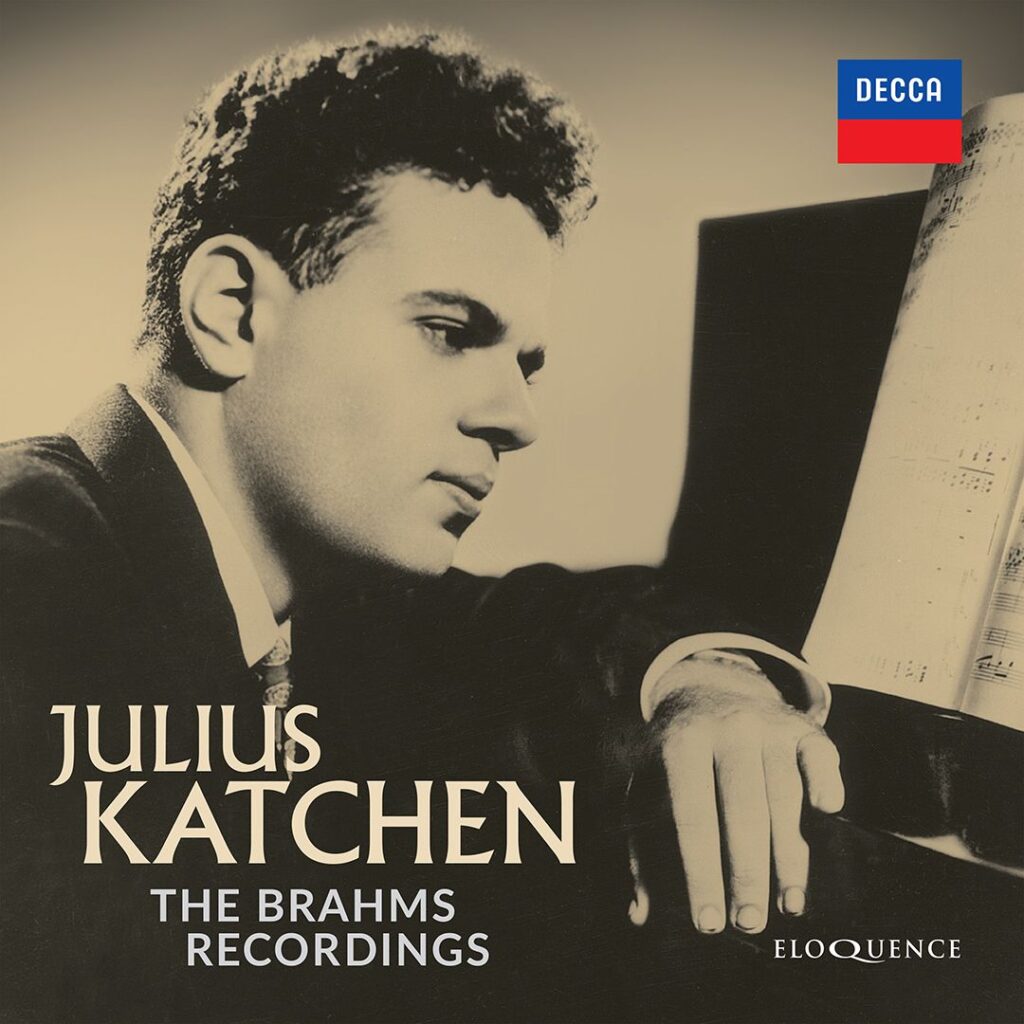
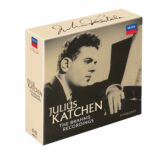
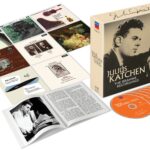
JULIUS KATCHEN CENTENARY – 15 AUGUST 2026
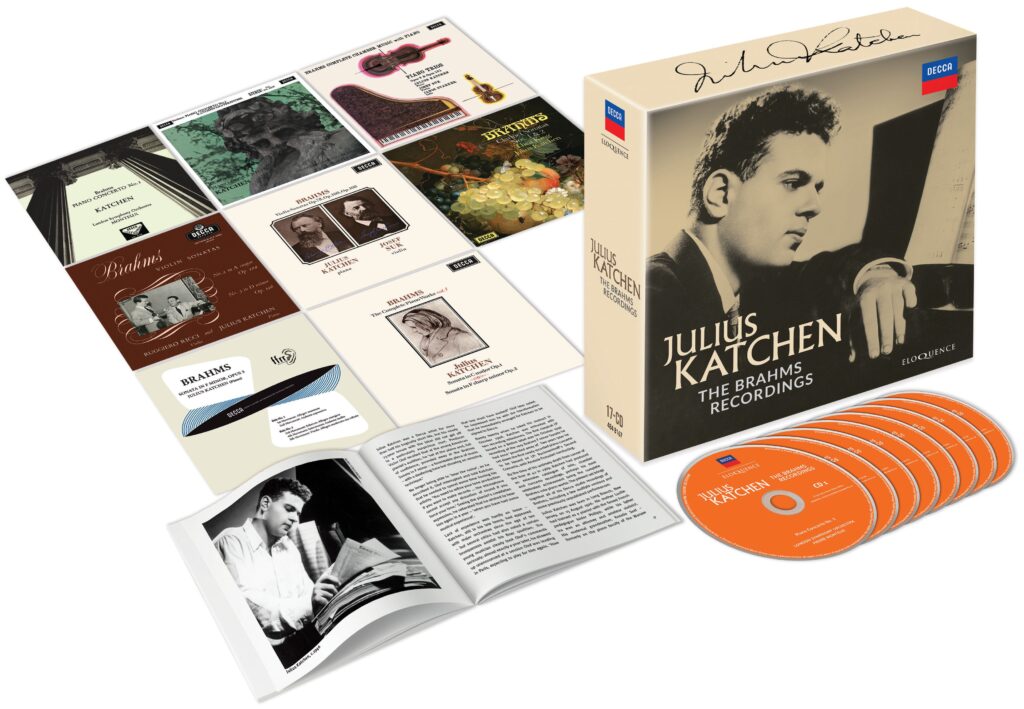
A complete collection of Julius Katchen’s Brahms recordings, featuring him as heroic concerto soloist, dynamic chamber-music partner and rugged, scintillating protagonist in the solo-piano music. Includes previously unreleased versions of the clarinet sonatas with Michel Portal, and the First Cello Sonata with János Starker, as well as several fascinating repertoire duplications between recordings made in the mono and stereo eras. LIMITED EDITION.
After Julius Katchen’s untimely death from cancer in April 1969, aged just 42, the tribute paid by his record label Decca could claim without hyperbole that Katchen was ‘one of the finest Brahms interpreters of his generation’. Less than 20 years earlier, he had burst like a firework onto the international scene with a record of Brahms’s F minor Sonata, which became the first solo-piano LP to be issued by Decca. Critics and listeners were quick to admire the muscular, aquiline profile of playing that felt true to Brahms as the ‘keyboard lion’ of his own generation.
In fact Katchen had made his debut on record a few months earlier, with the Handel Variations captured at Decca’s West Hampstead studios in April 1949. He would go on to re-record the Variations in both 1958 and 1962, and this new Eloquence box presents all three versions side by side for the first time, demonstrating how Katchen’s pianism matured during his brief career while losing none of its barnstorming virtuosity.
Katchen also recorded and then revisited the Paganini Variations, in 1959 and 1966, as well as the Third Sonata, as part of a stereo cycle of the complete solo piano works, made between 1961 and 1965. By then he had recorded both concertos, with the LSO conducted by Pierre Monteux and János Ferencsik. Towards the end of the 60s, Decca then captured him in timely manner as a sensitive partner to Josef Suk in the violin sonatas (which he had already recorded twice with Ruggiero Ricci in the 50s, both versions also being reissued here), the clarinet sonatas with Thea King, the cello sonatas with János Starker and piano trios with Suk and Starker.
As Mark Ainley outlines in his booklet essay, surveying Katchen’s meteoric career and special affinity with Brahms, the First Cello Sonata (a 1968 recording from Aldeburgh, made at the same time as the piano trios) was never issued; so too a 1967 set of the clarinet sonatas, in company with Michel Portal. With their first-ever release, this Decca Eloquence set presents the fullest possible portrait of Katchen as a sovereign interpreter of Brahms, capturing the music’s muscular energy, refined nuancing, and emotional breadth.
CD 1
Piano Concerto No. 1
London Symphony Orchestra / Pierre Monteux
CD 2
Piano Concerto No. 2
London Symphony Orchestra / János Ferencsik
CD 3
Piano Trios Nos. 1 & 3
Josef Suk, violin
János Starker, cello
CD 4
Piano Trio No. 2
Cello Sonatas Nos. 1* & 2
*PREVIOUSLY UNPUBLISHED
CD 5
Violin Sonatas Nos. 1–3 (1954 recordings)
Ruggiero Ricci, violin
CD 6
Violin Sonata Nos. 2 & 3
(1956 recordings)
Ruggiero Ricci, violin
CD 7
Violin Sonatas Nos. 1–3
Scherzo, WoO 2
Josef Suk, violin
CD 8
Clarinet Sonatas Nos. 1 & 2
Michel Portal, clarinet
PREVIOUSLY UNPUBLISHED
CD 9
Clarinet Sonatas Nos. 1 & 2
Thea King, clarinet
CD 10
Piano Sonata No. 3
Intermezzo, Op. 117 No. 1
Variations & Fugue on a Theme by Handel
(1949 recordings)
CD 11
Variations & Fugue on a Theme by Handel
Variations on a Theme by Paganini
(1958 recordings)
CD 12
Variations & Fugue on a Theme by Handel
Variations on a Theme by Paganini
(1962 recordings)
CD 13
Variations on a Theme by Schumann
Variations on an Original Theme
Variations on a Hungarian Song
Rhapsody in G minor, Op. 79 No. 2 (1961 recording)
CD 14
Hungarian Dances, WoO 1
Waltzes, Op. 39
Rhapsodies, Op. 79 (1964 recordings)
Jean-Pierre Marty, piano
CD 15
Piano Sonata Nos. 1 & 2
Klavierstücke, Op. 76
CD 16
Piano Sonata No. 3 (1964 recording)
Scherzo, Op. 4
Ballades, Op. 10
CD 17
Fantasien, Op. 116
Intermezzi, Op. 117 (1962 recordings)
Klavierstücke, Opp. 118 & 119
Julius Katchen, piano
“Brahms often brought out the best in Katchen… The playing is extremely brilliant and assured… [with] bravura controlled by a sensitive and musical mind.” Penguin Guide (Complete solo piano works)
“A splendidly impetuous performance, so well-shaped that its immature awkwardnesses are hardly noticeable… As to the recording, I don’t know when I’ve heard a piano sound so like a piano.” Musical Times, November 1950 (Sonata No.3)
“Katchen is a great pianist, here as elsewhere.” Hommes et mondes, December 1952 (Handel Variations)
“Katchen… is a pianist peculiarly well equipped for the interpretation of Brahms, and since this recording of the [Handel Variations] is one for which we have had to wait a long time, it is very gratifying to find it so well done, both musically and technically.” Irish Monthly, December 1952
“Both Katchen and Monteux bring to the music the qualities it needs: power, depth, breadth and wide-ranging passion.” Gramophone, April 1960 (Concerto No.1)
“Katchen is far from taking a selfish virtuoso line with the [Second] Concerto. He evidently knows the score in intimate detail, and always withdraws with consummate tact whenever the piano part becomes subsidiary.” Gramophone, November 1960
“The special value of this record is that Katchen is at the piano… I was constantly impressed by the excellent team-work.” Gramophone, June 1973 (Cello Sonata No.2; Piano Trio No.2)
“Suk and Katchen impart a late-summer mellowness to each [violin] sonata, though particularly to Op.78. This typifies the purity and directness of these interpretations, the finest in the catalogue.” Gramophone, September 1979
“Katchen was especially renowned for his Brahms… Katchen’s joyous take on [the Hungarian Dances] is delightfully witty and elegant.” Fanfare, March 1999“Superbly poised, virile, and highly satisfying performances.” Fanfare, September 2001 (Violin Sonatas – Suk)
“Scintillating and direct… fuelled by cocky virtuosity and overwhelming temperament.” Gramophone, February 2008 (Sonata No.3 – mono version)
“The [Third Sonata] exudes a re-creative spontaneity that remains unrivalled in the work’s large discography. Katchen seems to completely identify with every facet of Brahms’s early style.” Fanfare, September 2010 (Sonata No.3)
“A superbly intellectual tour de force.” High Fidelity, December 1961 (Handel Variations)
“Performances in what I think of as the ‘old style’ – sober, richly romantic, and heavily energetic.” High Fidelity, December 1961 (Piano Concertos)
“Katchen and his cohorts always manage to invest the music with linear energy without ever robbing it of its expressive allure… the idiomatic sensitivity of their playing is something to marvel at… A superb record.” High Fidelity, January 1974 (Piano Trios)
“Katchen’s playing has dash, intensity, lyricism and warmth. Always an excellent technician, he is not fazed by the intricacies of the ‘Paganini’ or the austerities of the ‘Handel’… These are mature readings, probably the best that Katchen has recorded. The engineering is excellent.” High Fidelity, August 1960 (Handel and Paganini Variations)
“An admirable match of strong, old-style string playing – no schmaltz but full tone and big phrase – with excellent, romantic pianism.” Stereo Review, December 1973 (Piano Trio No.3, Cello Sonata No.2)
“Both youthful soloist and venerable conductor display here their firm grasp of the Brahms style. Theirs is a noble and deeply thoughtful interpretation.” High Fidelity, June 1960 (Concerto No. 1)