
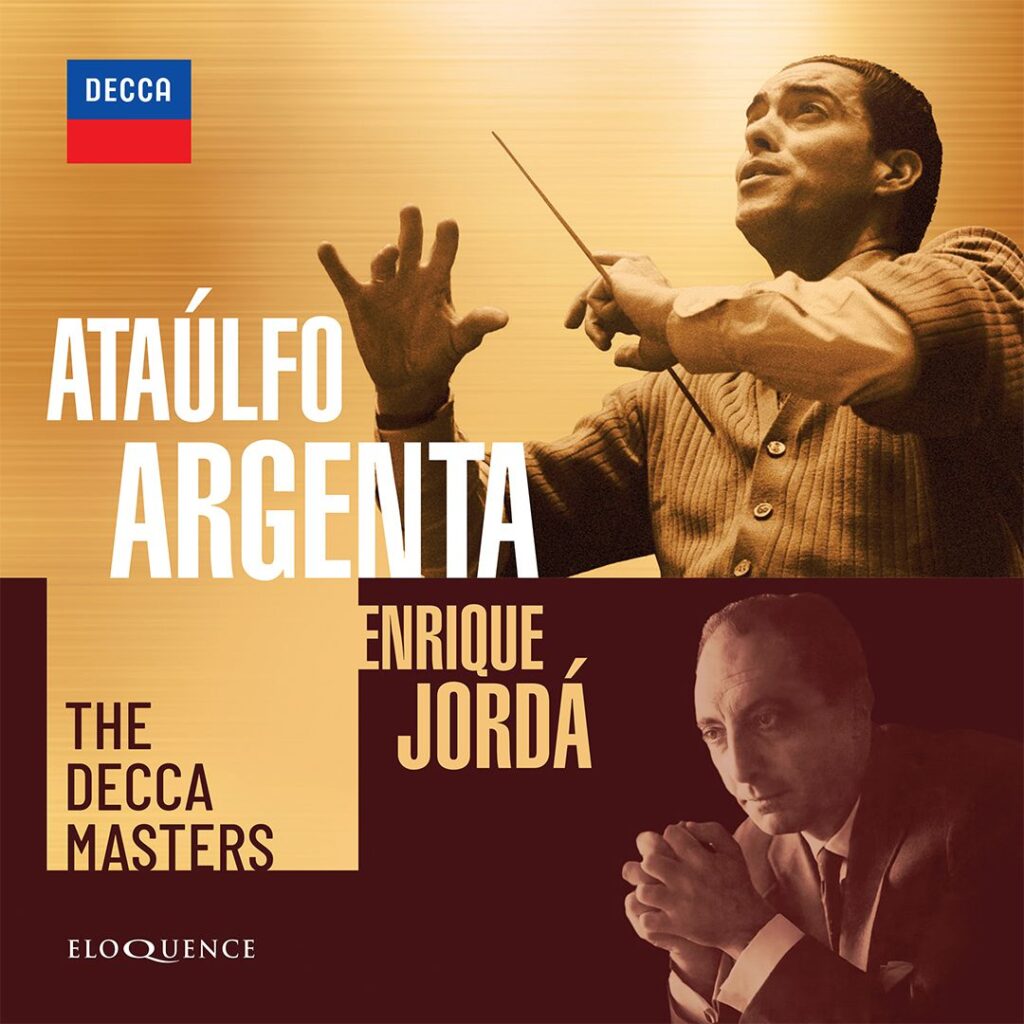
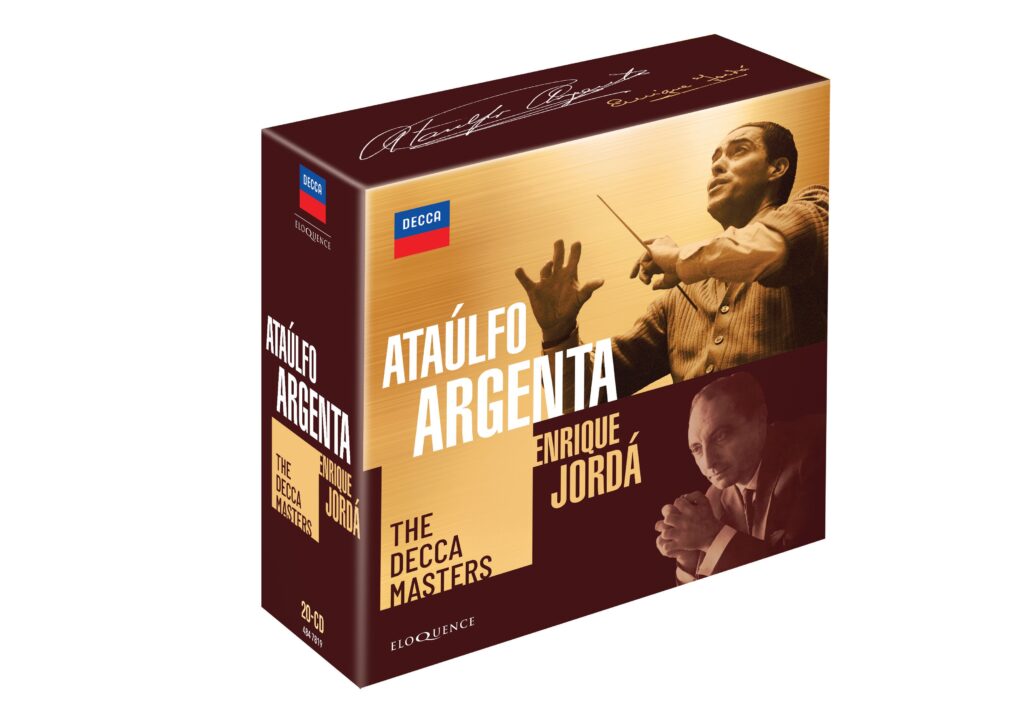
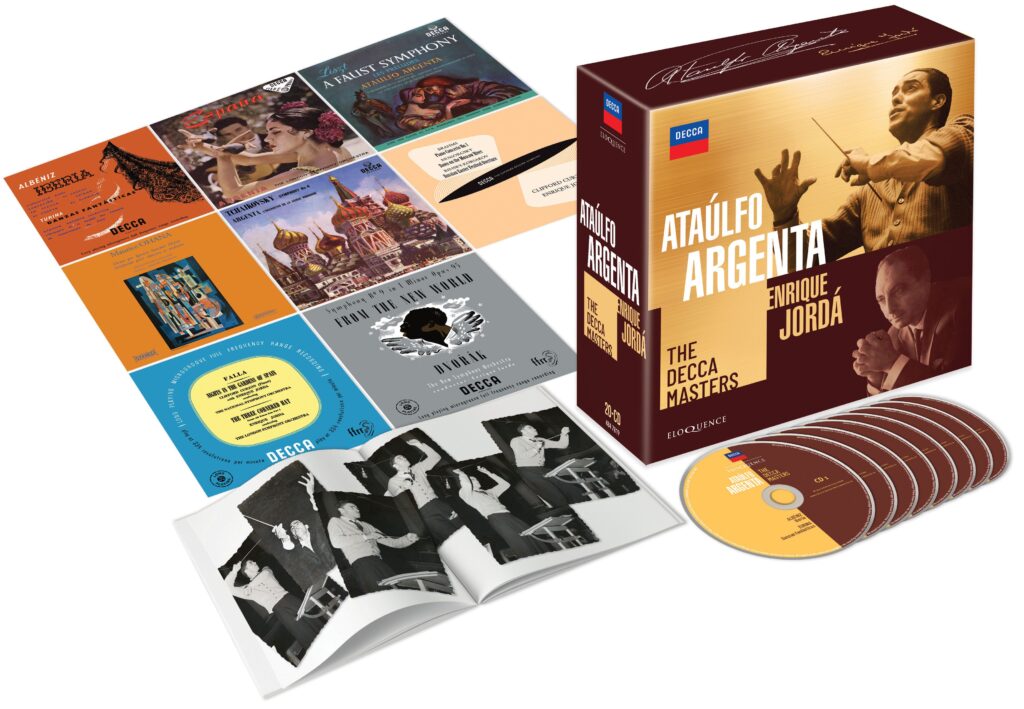


Ataúlfo Argenta and Enrique Jordá – two Spanish maestri in a single Decca collection, newly remastered, with ‘original jackets’, and several recordings receiving their CD premieres. LIMITED EDITION.
When Decca developed its revolutionary new ‘ffrr’ technology in the postwar 1940s, the label promoted it with a list of new recordings made by their most distinguished artists: Kathleen Ferrier, Victor de Sabata… and Enrique Jordá. Likewise, when Decca embraced the step-change of LP a few years later, they advertised its high fidelity and convenience with recordings made in Geneva by Ernest Ansermet and the young conductor he had determined upon as his successor in charge of the Orchestre de la Suisse Romande: Ataúlfo Argenta.
This set includes, for the first time, all the recordings made by Jordá in the 78 era, and receiving their first official digital remastering; his LP discography is also included. Jordá (born in 1911) and Argenta (born in 1913) were the first Spanish conductors to win an international reputation. They did so with the unmannered, dynamically vital interpretations of Romantic and 20th-century repertoire which Decca preserved in these recordings.
Both Argenta and Jordá were valued by orchestras and record labels as guarantors of authenticity in the Spanish orchestral repertoire by Falla, Albéniz, Turina, Rodrigo and others. But both conductors yearned to be recognised for their equal mastery of French and German repertoire. Listening now to Argenta conduct the Faust Symphony of Liszt and Schubert’s ‘Great’ C major, and Jordá in Haydn No. 88 and Mozart’s ‘Linz’ Symphony, we can hear the insights they bring to the Austro-German symphonic repertoire from a Hispanic angle.
Both conductors made early and near-definitive recordings of Nights in the Gardens of Spain, by Falla, and this set presents a fascinating opportunity to compare their approaches. Argenta’s career tragically ended with his death in 1958, aged just 44, while Jordá made a series of erratic career moves which culminated in an ill-starred tenure as music director in San Francisco. Under other circumstances, both conductors could have established a ‘Spanish school’ of conducting in the stereo age of the 1960s. This set illuminates the virtues of their common approaches to music, which through their Franco-German training in both cases brought together a sure grasp of form and rigour with a sensitivity to orchestral colour. The nature of that formation is explored in a new booklet essay written by Peter Quantrill, and the recordings are reissued in Eloquence’s ‘Original Jackets’ format.
CD 1
ALBÉNIZ: Iberia
TURINA: Danzas fantásticas
Orchestre de la Société des Concerts du Conservatoire de Paris / Ataúlfo Argenta
CD 2
BERLIOZ: Symphonie fantastique
Orchestre de la Société des Concerts du Conservatoire de Paris / Ataúlfo Argenta
CD 3
ESPAÑA – Rimsky-Korsakov, Granados, Chabrier, Moszkowski
London Symphony Orchestra
DEBUSSY: Images pour orchestre
Orchestre de la Suisse Romande
Ataúlfo Argenta
CD 4
FALLA: Harpsichord Concerto
Robert Veyron-Lacroix, harpsichord
El retablo de Maese Pedro
Julita Bermejo, soprano
Carlos Munguia, tenor
Raimundo Torres, baritone
Orquesta Nacional de España / Ataúlfo Argenta
FIRST CD RELEASE ON DECCA
CD 5
GRANADOS: Goyescas
Ana Maria Iriarte, soprano
Consuelo Rubio, soprano
Manuel Ausensi, baritone
Gines Torrano, tenor
Coros Cantores de Madrid
Orquesta Nacional de España / Ataúlfo Argenta
FIRST CD RELEASE ON DECCA
CD 6
HALFFTER: Sinfonietta
GURIDI: Ten Basque Melodies
ALBÉNIZ: Navarra
TURINA: La Procesión del Rocío; La Oración del torero
Orquesta Nacional de España / Ataúlfo Argenta
FIRST CD RELEASE ON DECCA
CD 7
LISZT: Eine Faust-Symphonie*
Les Préludes
Orchestre de la Suisse Romande / Ataúlfo Argenta
*FIRST CD RELEASE IN STEREO ON DECCA
CD 8
LISZT: Piano Concertos Nos. 1 & 2
Julius Katchen; London Philharmonic Orchestra / Ataúlfo Argenta
CD 9
OHANA: Llanto por Ignacio Sanchez Mejias; Sarabande
Denyse Gouarne, harpsichord (Sarabande)
Mauricio Molho, speaker (Llanto)
Bernard Cottret, baritone (Llanto)
Chœur des Cento Soli (Llanto)
Orchestre des Cento Soli / Ataúlfo Argenta
CD 10
RAVEL: Rapsodie espagnole*
Ma mère l’oye*; Alborada; Pavane*
Orchestre des Cento Soli / Ataúlfo Argenta
*FIRST CD RELEASE
CD 11
RODRIGO: Concierto de Aranjuez
Narciso Yepes, guitar
FALLA: Noches en los jardines de España
Gonzalo Soriano, piano
Orquesta Nacional de España / Ataúlfo Argenta
FIRST CD RELEASE ON DECCA
CD 12
SCHUBERT: Symphony No. 9
Orchestre des Cento Soli / Ataúlfo Argenta
CD 13
TCHAIKOVSKY: Symphony No. 4
Orchestre de la Suisse Romande
Violin Concerto
Alfredo Campoli; London Symphony Orchestra / Ataúlfo Argenta
CD 14
HAYDN: Symphony No. 88
National Symphony Orchestra
MOZART: Symphony No. 36
London Symphony Orchestra
LISZT: Les Préludes
Orchestre de la Société des Concerts du Conservatoire de Paris
Enrique Jordá
FIRST RELEASE ON CD
CD 15
BRAHMS: Piano Concerto No. 1
Clifford Curzon; National Symphony Orchestra
MUSSORGSKY: Dawn over the Moscow River (Khovanshchina)*
London Symphony Orchestra
RIMSKY-KORSAKOV: Russian Easter Festival Overture*
National Symphony Orchestra
Enrique Jordá
*FIRST RELEASE ON CD
CD 16
DEBUSSY: La Damoiselle élue – Prélude
DUKAS: L’apprenti sorcier
ALBÉNIZ: El Puerto (Iberia)
TURINA: Danzas fantásticas
National Symphony Orchestra / Enrique Jordá
FIRST RELEASE ON CD
CD 17
FALLA: El amor brujo*
Noches en los jardines de España [rec. 1945]
Clifford Curzon; National Symphony Orchestra
El sombrero de tres picos (Part I – excerpts)*
London Symphony Orchestra
El sombrero de tres picos (Part I – excerpts)*
National Symphony Orchestra
Enrique Jordá
*FIRST RELEASE ON CD
CD 18
DUKAS: L’apprenti sorcier
GLINKA: Ruslan and Lyudmila – Overture
CHABRIER: Danse slave (Le Roi malgré lui)
FALLA: Danza española No. 1 (La vida breve)
GRANADOS: Danzas españolas, H. 142
TURINA: La Procesión del Rocío
ALBÉNIZ: El Puerto; Triana (Iberia)
TCHAIKOVSKY: Francesca da Rimini
Orchestre de la Société des Concerts du Conservatoire de Paris / Enrique Jordá
CD 19
FALLA: Noches en los jardines de España [rec. 1951]
Clifford Curzon
DVOŘÁK Symphony No. 9
New Symphony Orchestra of London / Enrique Jordá
CD 20
RODRIGO: Fantasía para un gentilhombre
PONCE: Concierto del sur
BOCCHERINI: Concerto in D major, G. 476
Andrés Segovia; Symphony of the Air / Enrique Jordá
CDs 1–13: ATAÚLFO ARGENTA
CDs 14–20: ENRIQUE JORDÁ
“This is now the preferred version … The recording makes us all the more aware of our loss in this conductor’s premature death.” High Fidelity, February 1959 (Argenta – Falla: Nights in the Gardens of Spain)
“The Rodrigo guitar concerto is practically unknown in the United States, a situation that this beautiful recording should remedy.” High Fidelity, June 1955 (Argenta – Rodrigo: Concierto de Aranjuez)
“The late Ataúlfo Argenta clearly proves himself a peer of Monteux and Ansermet as an interpreter of Debussy … This release I unqualifiedly acclaim as one of – if not the – most completely successful examples of luminous and auditorium-authentic stereo sound currently available in disc form … Argenta himself could have no more impressive memorial.” High Fidelity, March 1959 (Argenta – Debussy: Images)
“For sheer exuberance and technical expertise, these performances are highly recommended.” High Fidelity, March 1959 (Katchen/Argenta – Liszt: Piano Concertos)
“One of the most satisfying of all recorded readings … His sensibility and sense of proportion and drama are everywhere evident … in stereo sound of matching sensibility and clarity.” High Fidelity, March 1959 (Argenta – Tchaikovsky: Symphony No. 4)
“Argenta conducts a lively performance with the Orquesta Nacional de España, and the singers – especially the women – are good.” High Fidelity, February 1958 (Argenta – Granados: Goyescas)
“I have nothing but the highest praise. Argenta infuses the music with ample warmth and dramatic fervour, and the engineering values are equally high.” High Fidelity, May 1956 (Argenta – Liszt: A Faust Symphony, Les Préludes)
“Argenta’s death last January appears more and more to have been a major loss to music … That he was a conductor who played Spanish music with brilliance and understanding is obvious in this disc … Falla’s little half-human, half-puppet opera gets a stylish presentation with sharpness and clarity of line again combined with subtlety and imagination in colouring.” High Fidelity, August 1958 (Argenta – Falla: El retablo de Maese Pedro)
“Superlative performances … The flashy, sensuous, exciting music receives the type of performance and recording it obviously calls for.” High Fidelity, September 1954 (Argenta – Albéniz: Iberia)
“A Spanish Carmina Burana, full of exciting, colourful, and very obvious effects … Performances and recordings are extremely good.” High Fidelity, September 1959 (Argenta – Ohana: Llanto por Ignacio Sanchez Mejias)
“The Schubert, with its ‘French’ French horn vibrato … is typical of the vitality this conductor could bring to his performances … the orchestra plays well enough that it really seems to be made up of ‘100 soloists.’” Fanfare, November 2002 (Argenta – Schubert: Symphony No. 9)
“Argenta, who is represented on Decca chiefly in works of Spanish influence or origin, conducts a reading that reveals fully his rare talent. It is too bad that Decca did not have him record more non-Spanish repertoire. His musicianship and his way with the Paris Conservatoire Orchestra are outstanding. The Parisian ensemble has not played this well for more famous conductors! Throughout the recording there is excellent discipline.” Stereo Review, November 1958 (Argenta – Berlioz: Symphonie fantastique)
“Argenta gives us his finest performance on records here … a penetrating and exciting reading. I have seldom heard a more perfectly disciplined interpretation, but not once is there even a hint of mechanical dryness in phrasing or of tone. In one sense the reading is reminiscent of Toscanini’s, except that Argenta never gives the impression of over-tautness.” Stereo Review, November 1958 (Argenta – Debussy: Images)
“Throughout, Argenta’s authoritative hand is evident and the poem is movingly voiced by narrator Molho … An archaic quality, reminiscent of medieval chants, pervades the music, and it is faithfully captured in the vocal inflections of the soloist and chorus.” Stereo Review, August 1959 (Argenta – Ohana: Llanto por Ignacio Sanchez Mejias)
“Argenta’s view of the music is warm, leisurely and colourful in a way that is winningly un-insistent … Ibéria comes off here as I have rarely heard it, and the only explanation I can find for the conductor’s success with it is the sense of relaxation that pervades the playing over the entire disc.” Stereo Review, May 1968 (Argenta – Debussy: Images)
“A delightful set: sonorous, keen, gay and well recorded.” Gramophone, January 1946 (Jordá – Falla: Nights in the Gardens of Spain)
“Two records which should not be missed … playing and recording are superb.” Gramophone, March 1952 (Jordá – Albeniz/ Falla/Turina and Chabrier/Dukas/Glinka)
“Jordá’s weighty and deliberate opening of the Miller’s farruca sends a shiver of pleasurable anticipation down the spine.” Gramophone, April 1996 (Jordá – Falla: El amor brujo)
“This tender preface will please everyone, recorded so delicately and with such good taste.” Gramophone, February 1947 (Jordá – Debussy: La Damoiselle élue)
“Here is the Russian ikon-painting – joy in colour … many orchestral combinations come out quite thrillingly.” Gramophone, June 1947 (Jordá – Rimsky-Korsakov: Russian Easter Festival Overture)
“Jordá, a dependable conductor, gives a performance to match, nicely warm in his lyrical moments.” High Fidelity, October 1954 (Jordá – Tchaikovsky: Francesca da Rimini)
“Mr. Curzon’s playing is poetic in the Falla … Enrique Jordá does a fine job.” High Fidelity, September 1956 (Jordá – Falla: Nights in the Gardens of Spain)
“Jordá produces some tasty effects, making the orchestra play with unusual style, aplomb and finesse.” Gramophone, June 1948 (Jordá – Falla/Mussorgsky)
“Beautifully smooth work, and subtle musicianship in the treatment … this one would be very difficult to beat.” Gramophone, July 1948 (Jordá – Liszt: Les Préludes)
“A keen, deft recording, in excellent Haydn-heart, with good use of the wind.” Gramophone, January 1949 (Jordá – Haydn: Symphony No. 88)