

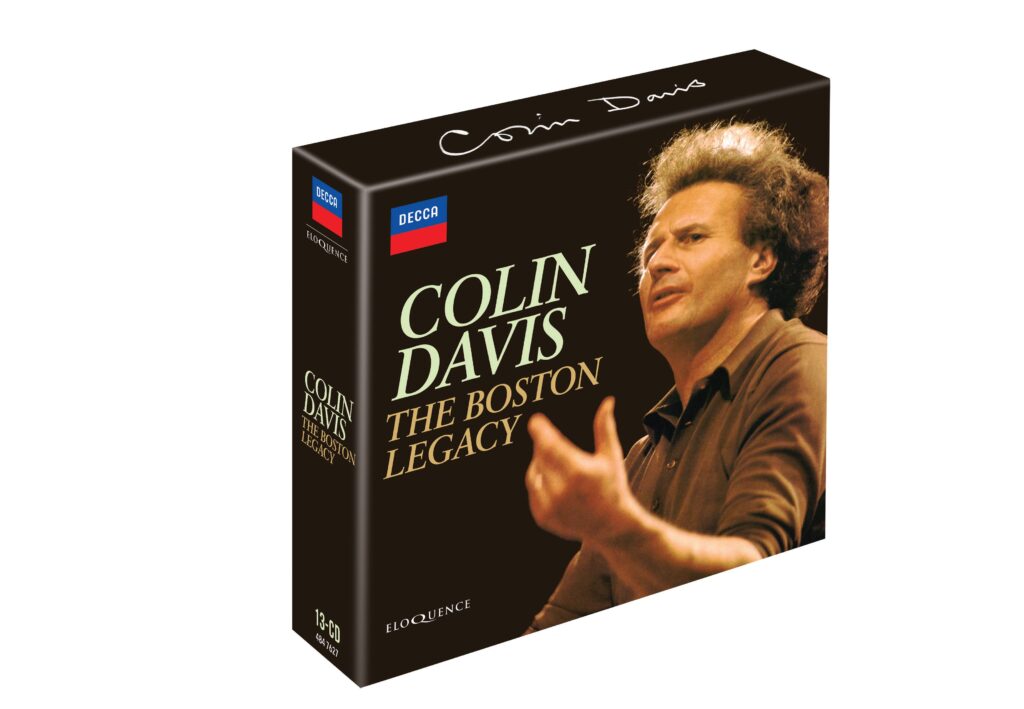
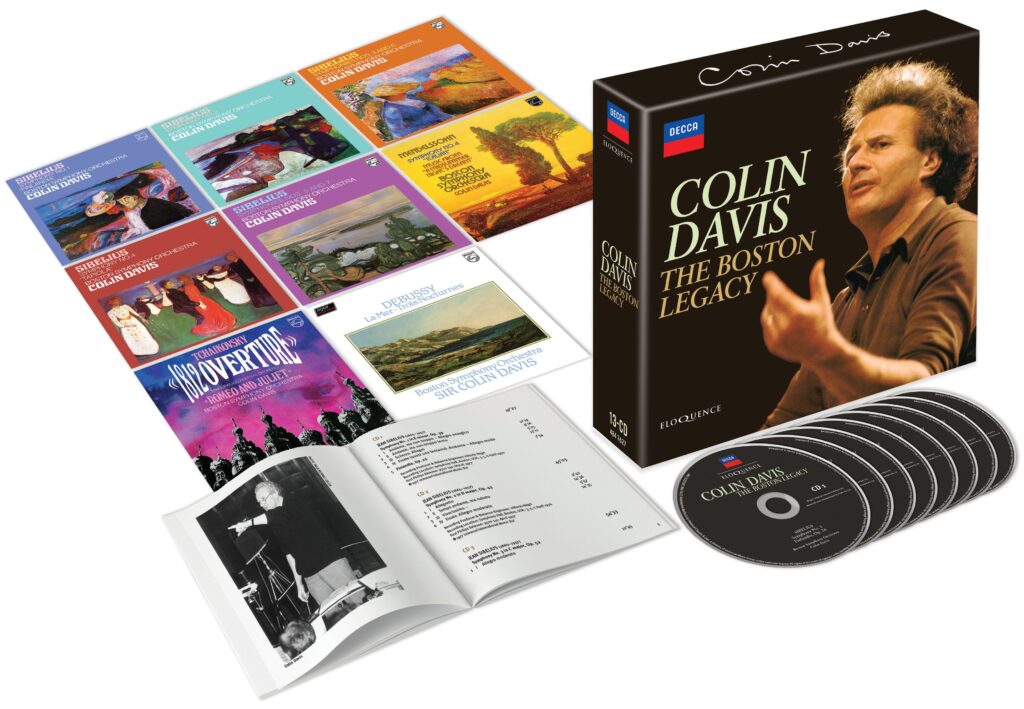



Reissued complete for the first time, the recorded legacy of Sir Colin Davis and the Boston Symphony Orchestra on Philips, including an unsurpassed cycle of Sibelius symphonies.
Each element of the tricky chemistry came off when Colin Davis made his debut with the Boston Symphony Orchestra in 1967, in concerts of Berlioz, Stravinsky and Dvořák. In search of a new Principal Conductor at the time, the BSO offered the post to Davis, but he preferred to focus his energies on the directorship of the Royal Opera in London. However, he began making regular return visits to Boston, and in 1974 became the orchestra’s Principal Guest Conductor.
As the most ‘European’-sounding of the great American orchestras, the BSO responded with natural affinity to Davis’s sense of line and cultivated warmth in canon repertoire. When he began to explore Sibelius with them, both the orchestra and audience responded with cautious curiosity which blossomed into committed enthusiasm. Philips capitalised on this affinity by recording them together in the complete symphonies and selected tone-poems between 1975 and 1980, successfully capturing the intensity of the associated concerts.
While the Sibelius cycle has maintained a firm place in the catalogue, other albums in the BSO/Davis discography have fallen from prominence. They include a fizzing Mendelssohn album of the ‘Italian’ Symphony and excerpts from A Midsummer Night’s Dream; a delectably sprung set of excerpts from Schubert’s Rosamunde, and one of the first-ever versions of the ‘Great’ C major Symphony to include all the repeats.
Davis had a long-established harmonious working relationship with Claudio Arrau, and the Chilean pianist came to Boston to record magisterial, lovingly detailed versions of the concertos by Schumann, Grieg and Tchaikovsky. While Tchaikovsky is hardly a name associated with Davis, the conductor also drew remarkable tension, energy and volume from his Boston forces in Romeo and Juliet and the 1812 Overture (complete with chorus, organ, bells and the rest).
This Original Covers box from Eloquence comprises newly remastered recordings and includes a new booklet essay by Peter Quantrill, exploring the history of Colin Davis in Boston, the elements of their happy artistic chemistry and the stories behind the scenes.
CD 1
SIBELIUS Symphony No. 1
Finlandia
CD 2
SIBELIUS Symphony No. 2
CD 3
SIBELIUS Symphonies Nos. 3 & 6
CD 4
SIBELIUS Symphony No. 4
Tapiola
CD 5
SIBELIUS Symphonies Nos. 5 & 7
CD 6
SIBELIUS The Swan of Tuonela
Pohjola’s Daughter; Valse triste
Karelia Suite; En Saga
CD 7
SIBELIUS Violin Concerto
Six Humoresques
Salvatore Accardo
London Symphony Orchestra
CD 8
SCHUBERT Symphony No. 8
Rosamunde (excerpts)
CD 9
SCHUBERT Symphony No. 9
CD 10
MENDELSSOHN Symphony No. 4 ‘Italian’
A Midsummer Night’s Dream (excerpts)
CD 11
TCHAIKOVSKY 1812 Overture
Romeo and Juliet
Piano Concerto No. 1
Claudio Arrau
CD 12
GRIEG Piano Concerto
SCHUMANN Piano Concerto
Claudio Arrau
CD 13
DEBUSSY La Mer
Nocturnes
“Davis’s rhythmic certainty, his generously sweeping but tautly controlled feel for Romantic phrasing, suffuse the music with adrenalin.” High Fidelity, December 1975 (Sibelius: Symphonies Nos. 5 & 7)
“A vital, full-bodied account of the ‘Italian’ Symphony; a reading caught in full, mellow sound. From the first, the playing is both alive and spacious.” Gramophone, November 1976 (Mendelssohn)
“Davis strikes the right balance between the overall design and attention to detail, and he shapes the whole structure as well as the component parts with conviction and authority. The very opening has a wholly authentic sense of atmosphere, and the clarinet playing in itself is of a high order of sensitivity.” Gramophone, March 1977 (Sibelius: Symphony No.1)
“Totally unmannered and at times refreshingly understated without ever being under-characterised or wanting in sensitivity… He strikes just the right balance between the nationalist-romantic inheritance on the one side and the classical power of Sibelius’s thinking on the other.” Gramophone, April 1977 (Sibelius: Symphony No.2)
“The finale [of Symphony No. 3] is superb; there is none better, not even Kajanus! … This is a completely un-egoistic performance, devoid of any mannerisms or interpretative point-making; hence it is paradoxically the most truly characterful. The Sixth is finely conceived and beautifully played.” Gramophone, August 1977 (Sibelius: Symphonies Nos. 3 & 6)
“No one listening to Colin Davis’s cycle of Sibelius symphonies will be left in any doubt that here is a born Sibelian.” Gramophone, September 1977
“A dignified and noble performance that rises to moments of real poetry.” High Fidelity, December 1977 (Sibelius: Symphony No.2)
“In No. 6 Davis summons up the tonal sheen, glittering like fine crystal, of which the Boston Symphony Orchestra is capable at its best… Davis’s performances speak for [these works] about as eloquently as I can imagine in this imperfect world. This is one of the great records of our time.” High Fidelity, January 1978 (Sibelius: Symphonies Nos. 3 & 6)
“Super-charged ferocity, gleaming and polished sonority, stupendously controlled dynamics.” High Fidelity, March 1978 (Sibelius: Tapiola)
“Totally idiomatic and deeply impressive… a deeply felt reading which has concentration and atmosphere. Moreover, the response of the Boston Symphony Orchestra is of the highest order of virtuosity and sensitivity… More than almost any other version on record, this conveys a sense of stillness and communing with nature.” Gramophone, August 1978 (Sibelius: Symphony No. 4)
“A direct and unexaggerated reading which is most refreshing… lovers of Arrau’s playing will not be disappointed.” Gramophone, May 1980 (Tchaikovsky: Piano Concerto No. 1)
“Arrau and Davis stress the lyrical substance… a stately and aristocratic approach.” Stereo Review, October 1980 (Tchaikovsky: Piano Concerto No. 1)
“With power and concentration… Arrau and Davis make an organic whole of the performance.” High Fidelity, September 1980 (Tchaikovsky: Piano Concerto No. 1)
“An unusual and, of course, interesting performance… Arrau plays the Andantino with great delicacy and perception.” Gramophone, February 1982 (Schumann: Piano Concerto)
“Arrau takes a proprietary view of both works, shaping the phrases lovingly… one can only admire the state of his virtuosity as he enters his 80s.” High Fidelity, December 1982 (Schumann/Grieg: Concertos)
“Davis, the great Berlioz interpreter, is here relating [Tchaikovsky] to the comparable programmatic and colourful work of the French composer, similarly refusing to coarsen sharply defined ideas brilliantly orchestrated… Much is owed to the refinement of the playing.” Gramophone, July 1982 (Tchaikovsky: Overtures)
“Grand and glorious… an essentially musical performance as well as a dandy demo item for sound buffs.” Stereo Review, September 1982 (Tchaikovsky: Overtures)
“A highly original and compelling view of the music, a reminder that Debussy was at least as close to the Symbolists as to the Impressionists.” Gramophone, July 1983 (Debussy)
“This new La Mer is one to which I will often want to return… there is always the sense of tremendous reserves of power held in restraint. Thus the climaxes when they are unleashed… seem as powerful as those of nature herself.” Gramophone, November 1983 (Debussy)
“I cherish the record most for the joyful account of Rosamunde… for there with rhythms delectably sprung the result has the electricity of a live performance.” Gramophone, April 1984 (Schubert)
“The idiomatic playing Davis secures from the Boston orchestra is immediately apparent… There is a genuine sense of commitment and power… In No. 3 Davis judges the tempi to perfection; no conductor has captured the elusive spirit of the slow movement or the power of the finale more effectively.” Penguin Guide (Sibelius symphonies)
“Sibelius conducting and playing doesn’t get much better than this… No rival in No. 3 has yet managed to surpass Sir Colin Davis in Boston.” Gramophone, March 2023 (Symphony No. 3)