
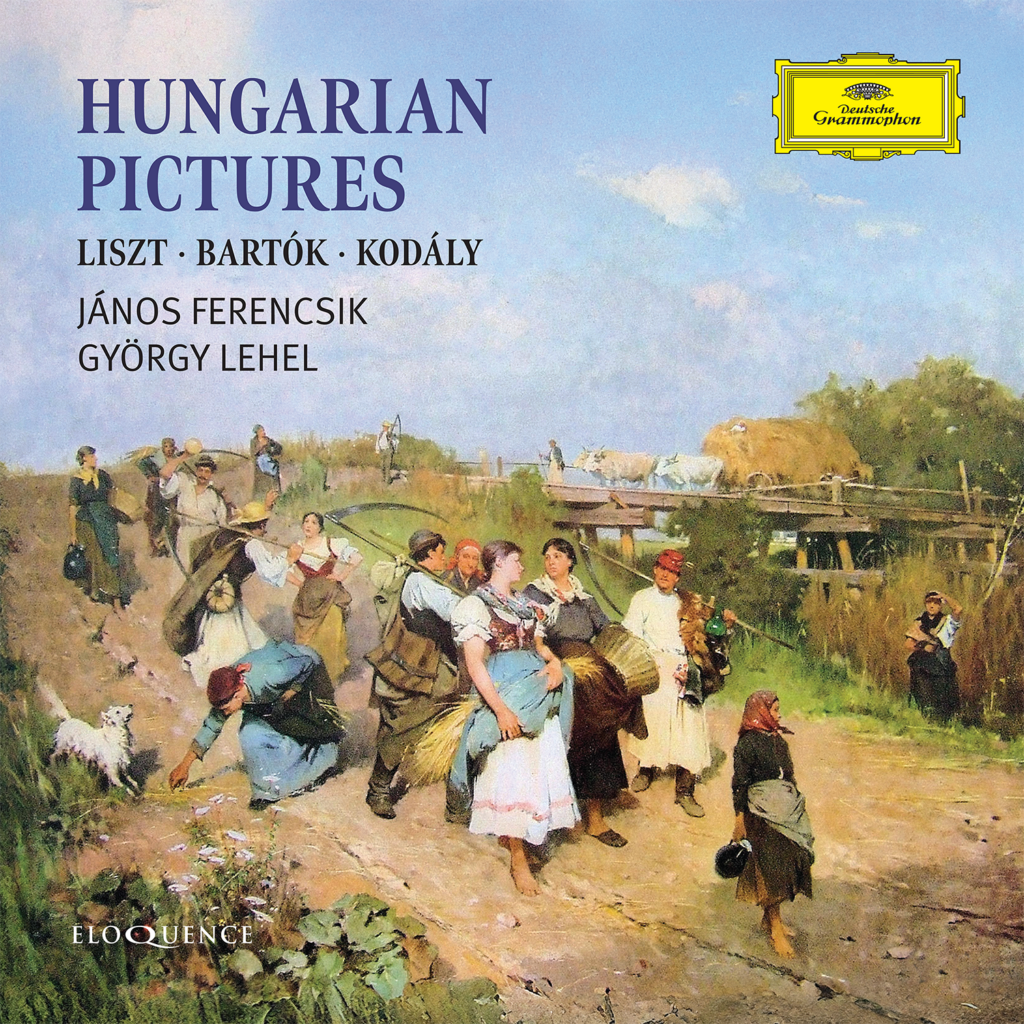
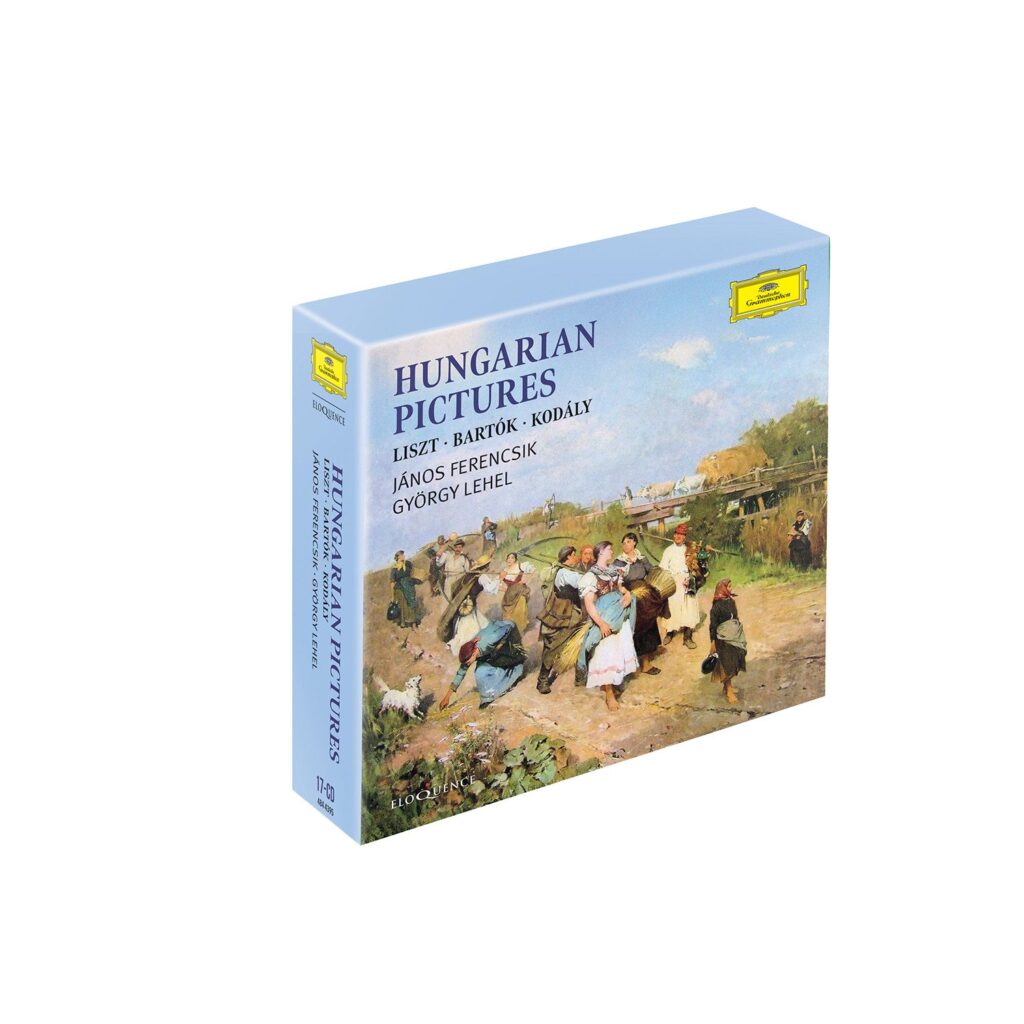
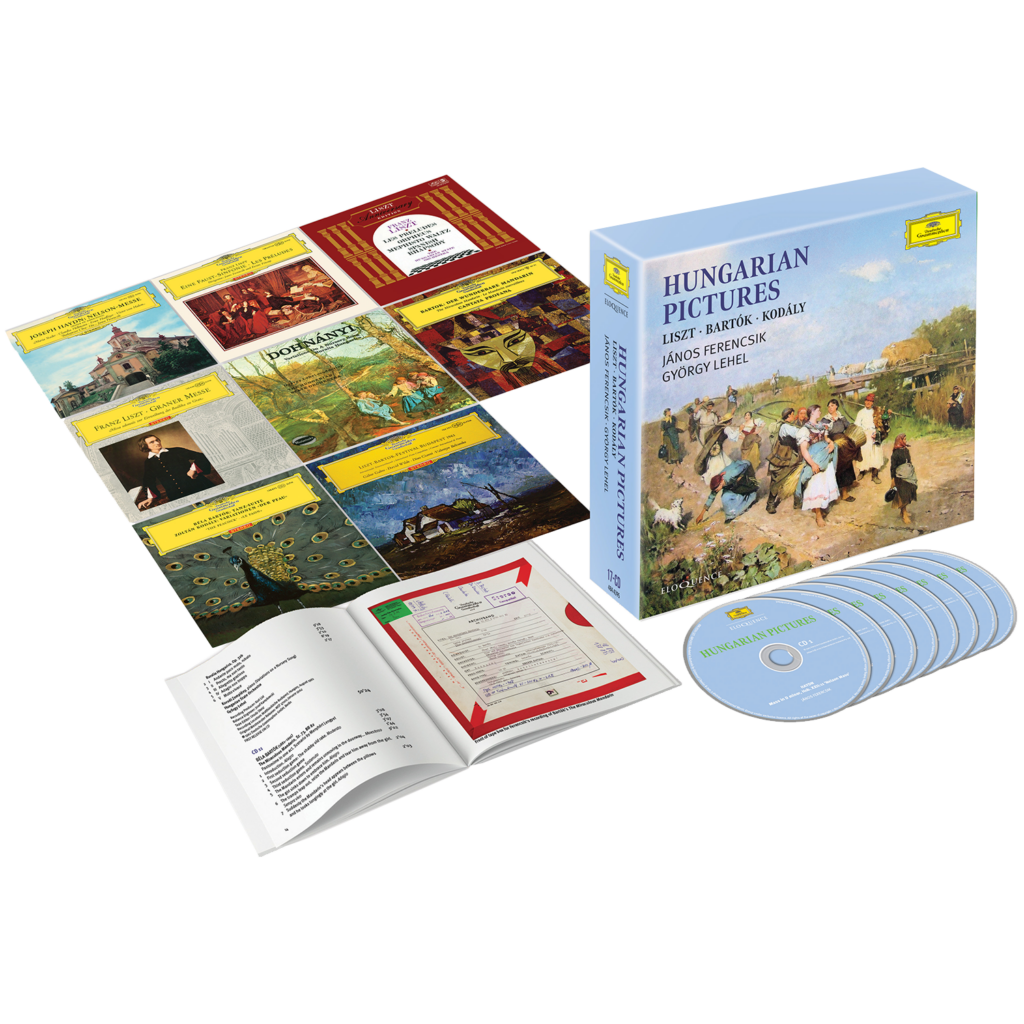
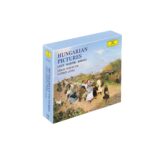

Hungarian Pictures presents recordings of music by Liszt, Bartók, Kodály and Dohnányi in recordings of native authority, many of them making their first appearance on CD. János Ferencsik and György Lehel were leading orchestras who knew their style intimately, and who had the Hungarian rhythms of this music flowing in their blood.
In the 1960s, Deutsche Grammophon and the Westminster label introduced listeners to much fascinating Hungarian repertoire which they had never previously encountered. This Eloquence set of ‘Hungarian Connections’ gathers up these rare recordings for the first time and reissues them in newly remastered versions with original covers.
A booklet essay by Peter Quantrill explores the careers of the two principal musicians leading the music-making on the set, János Ferencsik and György Lehel. These were both conductors who did not flee Hungary when the revolution was so brutally suppressed by the Communists in 1956. Accordingly, they came to play a central role in musical culture in postwar Budapest, with Ferencsik based at the Opera and Lehel at the Radio and TV company.
Ferencsik and Lehel were leading orchestras who knew their style intimately, and who had the Hungarian rhythms of this music flowing in their blood: Ferencsik remarked that he performed Bartók’s music as naturally as if he were breathing. No less compelling is the single album issued by DG of Kodaly conducting his own music, which introduced the shimmeringly evocative tone-poem Summer Evening to many western listeners.
Finally, there is a single LP of highlights from the 1961 Liszt-Bartok Piano Competition, held in Budapest: the winner Gábor Gabos gives a thunderously eloquent account of Liszt’s Piano Sonata, and there are further performances by the young Dino Ciani, Valentin Belchenko and David Wilde.
Hungarian Connections is a feast of rare recordings which no collector will want to miss.
CD 1
HAYDN Mass in D minor, Hob. XXII:11 ‘Nelson Mass’
János Ferencsik
FIRST INTERNATIONAL RELEASE ON CD
CD 2
LISZT A Faust Symphony
János Ferencsik
FIRST RELEASE ON CD
CD 3
LISZT Dante Symphony
György Lehel
Tasso – Lamentoso e Trionfo
János Ferencsik
FIRST RELEASE ON CD
CD 4
LISZT Hungaria; Orpheus; Mephisto Waltz No. 1
János Ferencsik
Les Préludes; Rapsodie espagnole
György Lehel
FIRST RELEASE ON CD
CD 5
LISZT Fantasia on Hungarian Folk Tunes
Sviatoslav Richter · János Ferencsik
Deux Légendes; Cantico del sol di Francesco d’Assisi
Gerd Albrecht
CDs 6–7
LISZT Die Legende von der Heiligen Elisabeth
Siegfried Heinrich
CD 8
LISZT Missa solemnis ‘Graner Messe’
János Ferencsik
CD 9
LISZT Hungarian Coronation Mass
János Ferencsik
CD 10
DOHNÁNYI Variations on a Nursery Song; Ruralia Hungarica
Kornél Zemplény
György Lehel
FIRST RELEASE ON CD
CD 11
BARTÓK The Miraculous Mandarin
János Ferencsik
Cantata profana
György Lehel
FIRST RELEASE ON CD
CD 12
BARTÓK Dance Suite
KODÁLY Peacock Variations
György Lehel
FIRST RELEASE ON CD
CD 13
BARTÓK Viola Concerto
DÁVID Viola Concerto
Pál Lukács
János Ferencsik
FIRST RELEASE ON CD
CD 14
BARTÓK Village Scenes
Music for Strings, Percussion and Celesta
György Lehel
FIRST RELEASE ON CD
CD 15
BARTÓK Piano Concertos Nos. 1 & 2
Kornél Zemplény (No. 1)
Tibor Wehner (No. 2)
János Ferencsik
FIRST RELEASE ON CD
CD 16
KODÁLY Summer Evening
Concerto for Orchestra
Zoltán Kodály
CD 17
1961 LISZT–BARTÓK COMPETITION
LISZT Piano Sonata; Mazeppa; Funérailles
BARTÓK Out of Doors
Gábor Gabos ∙ David Wilde
Valentin Belcsenko ∙ Dino Ciani
FIRST RELEASE ON CD
“Excellent, especially the handling of the Gretchen movement.” Gramophone, September 1962 (Faust Symphony)
“Many readers might very much enjoy this unexpected DG record, if only they would give it a chance … a really beautiful piece of music … The performance is ardent.” Gramophone, April 1962 (Liszt: Hungarian Coronation Mass)
“There are many, many inspired details … the recording was done in the St. Matthias Church, Budapest, which was the site of the initial performance. The full, resonant sound enjoys an even greater spread in stereo.” High Fidelity, October 1961 (Liszt: Hungarian Coronation Mass)
“The new Ferencsik edition, aided by gorgeous sonics from Hungarian Qualiton’s recording staff, is a first-class performance … that focuses one’s attention on the deeply spiritual, intellectual values of Liszt’s writing and helps to clarify the frequently ingenious harmonic scheme.” High Fidelity, November 1962 (Liszt: Faust Symphony)
“There is refinement in the contrapuntal Purgatorio and beautiful blending of voices and orchestra in the inspired Magnificat.” High Fidelity, April 1962 (Liszt: Dante Symphony)
“Lehel throws himself into the music with much enthusiasm and verve … The reproduction in both works is notable for its range, brightness, and transparency.” High Fidelity, May 1962 (Dohnányi)
“The choral singing here is excellent … Lehel seems highly capable.” High Fidelity, July 1974 (Bartok: Cantata, Miraculous Mandarin)
“Most successful in the projection of the Hungarian externals, which are beautifully managed.” High Fidelity, August 1964 (Bartók, David: Viola Concertos)
“Kodály conducts with as much clarity and refinement as he composes, and excellent recording completes the cycle.” High Fidelity, December 1961 (Kodály conducts Kodály)
“The Hungarian Coronation Mass is probably the most immediately attractive of all Liszt’s sacred works … János Ferencsik and his associates give it a powerful and convincing performance, and the 1861 recording hardly shows its age.” Stereo Review, January 1983 (Liszt: Hungarian Coronation Mass)
“Ferencsik handles the closing pages beautifully [Miraculous Mandarin] … Thanks to the excellence of the soloists, this is the best available version of the Cantata Profana.” Stereo Review, July 1964
“Presented with colour and excitement [Village Scenes] … Lehel is particularly effective in capturing the dance rhythms of the two fast movements.” Stereo Review, September 1973 (Bartók: Music for Strings, Percussion and Celesta, etc.)
“I was singularly impressed by the full-blooded rhythmic vitality and tonal body of the Budapest Chorus … Ferencsik is vigorous, closer to the early 19th-century symphonic manner than to the Austrian Baroque.” Stereo Review, September 1967 (Haydn: Nelson Mass)
“[Tibor Wehner’s] performance is absolutely sizzling – in fact the first truly satisfactory reading that I have heard of this exacting music. Ferencsik and the orchestra back him perfectly.” Stereo Review, May 1962 (Bartók: Piano Concerto No. 2)
“I am very much taken by Valentyn Belcsenko’s broad, singing delivery of Funérailles. Rather than indulging in the usual tawdry fireworks, he evokes a gentle, nostalgic atmosphere of quiet resignation … Gabos has fine technique, sonorous tone, and a good deal of vigorous abandon.” High Fidelity, May 1963 (Liszt–Bartók Competition)